
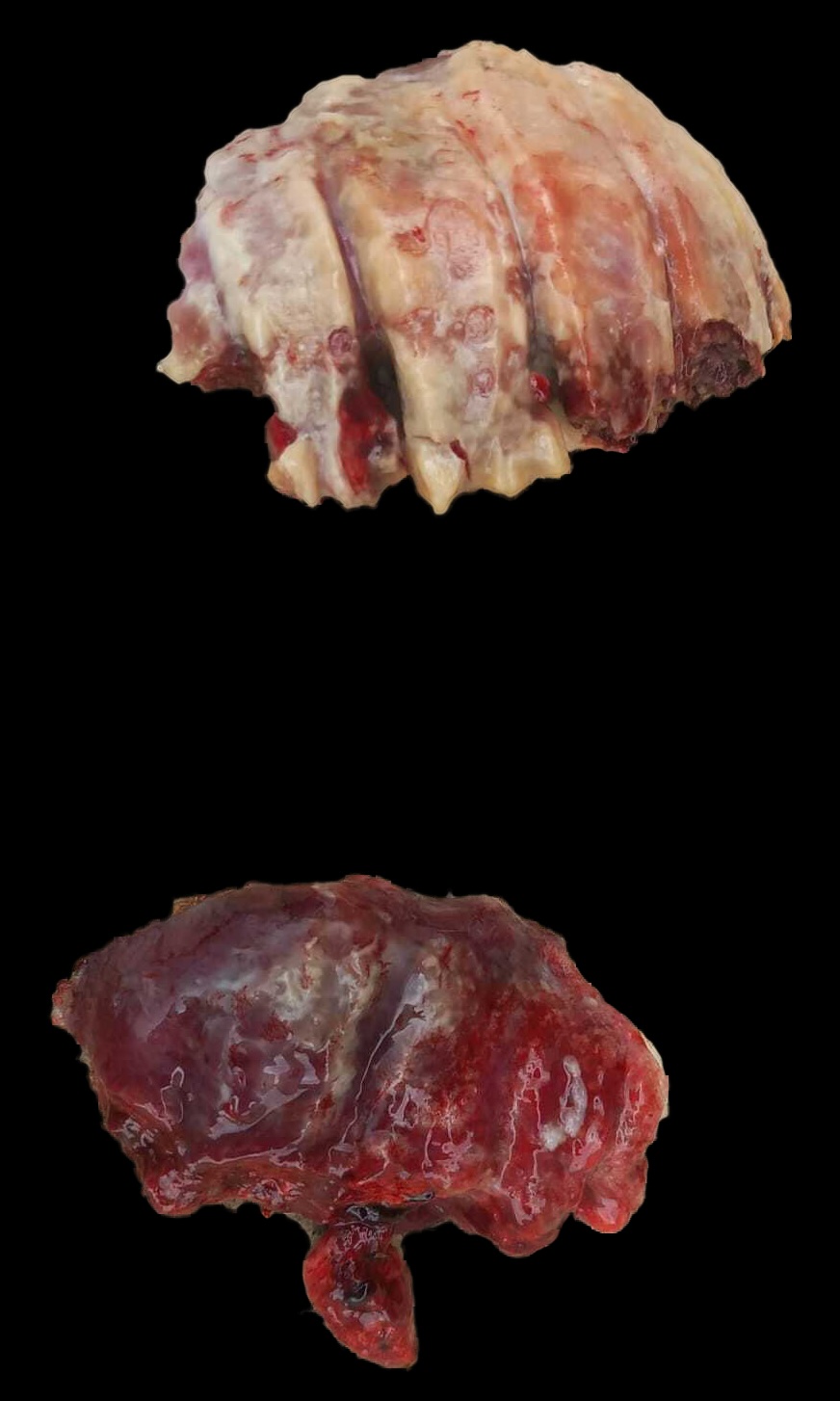
Animal: Turkey, male, 68-day-old.
Organ: Lungs.
History: On a farm with approximately 5,000 fattening turkeys, mild coughing was initially observed, with no associated mortality. The dry cough progressively became more widespread and severe. By the end of the fattening period, the mortality rate in the affected flock had reached 13 %.
Macroscopic findings: The pleura of lungs were covered by a thick layer of fibrin, which multifocally extended into and adhered to the pulmonary parenchyma. The pulmonary parenchyma was diffusely and markedly hyperemic, with multifocally to randomly distributed areas of necrosis.
Microscopic findings: The pleura was diffusely thickened and replaced by a fibrinous exudate containing innumerable heterophils and numerous extravasated erythrocytes. In these areas, numerous blood vessels contained thrombi. The pulmonary alveoli were markedly expanded by oedema, fibrin, and numerous bacterial colonies. The interalveolar septa were diffusely edematous and exhibited areas of necrosis. The bronchial and parabronchial epithelium was multifocally necrotic and detached from the underlying mucosa, with the affected lumina containing a prominent suppurative exudate.
Morphological diagnosis: Lung: Diffuse, severe, subacute fibrinosuppurative pleurobronchopneumonia.
Additionaly testing: Bacterial culture and PCR confirmed the presence of Ornithobacterium rhinotracheale in affected lung and air sac samples.
Etiology: Ornithobacterium rhinotracheale.
Comment: Ornithobacterium rhinotracheale commonly affects the respiratory tract of turkeys, particularly the lungs and air sacs. Transmission is predominantly horizontal, although vertical transmission has also been reported. Risk factors such as high levels of dust and ammonia within poultry farms, as well as concurrent primary viral infections, particularly avian metapneumovirus infection, may play an important role in disease development and severity. Bacterial culture is useful for differentiating O. rhinotracheale infection from other bacterial respiratory pathogens, including Pasteurella multocida, Chlamydia psittaci, and Escherichia coli.
References
Swayne, D. E., Boulianne, M., Logue, C. M., McDougald, L. R., Nair, V., Suarez, D. L., de Wit, S., Grimes, T., Johnson, D., Prajitno, T. Y., Rubinoff, I., & Zavala, G. (Eds.). (2019). Diseases of poultry (14th ed.). Wiley.
Barbosa, E. V., Cardoso, C. V., Silva, R. D. C. F., Cerqueira, A. D. M. F., Liberal, M. H. T., & Castro, H. C. (2019). Ornithobacterium rhinotracheale: An update review about an emerging poultry pathogen. Veterinary sciences, 7(1), 3.
Contributors: Álex Gómez1,2*, Lucía Barreno San Antolín1, Fco Javier Trócoli3.
1Laboratorios Gasset, Grupo DAV Salud, Granada, Spain.
2Departamento de Patología Animal, Universidad de Zaragoza, Zaragoza, Spain.
3PROCAVI SL, Marchena, Sevilla, Spain.